The Problem Nobody Talks About
Every local business, whether it's a gym, a restaurant, a hotel spa, or an entertainment venue, faces the same invisible problem. They have customers who walk through the door, spend money, enjoy the experience, and then vanish into thin air. There's no relationship between visits. No way to reach them at the right moment. No data on what they did, when they came back, or why they stopped coming.
The typical solutions are familiar and increasingly broken.
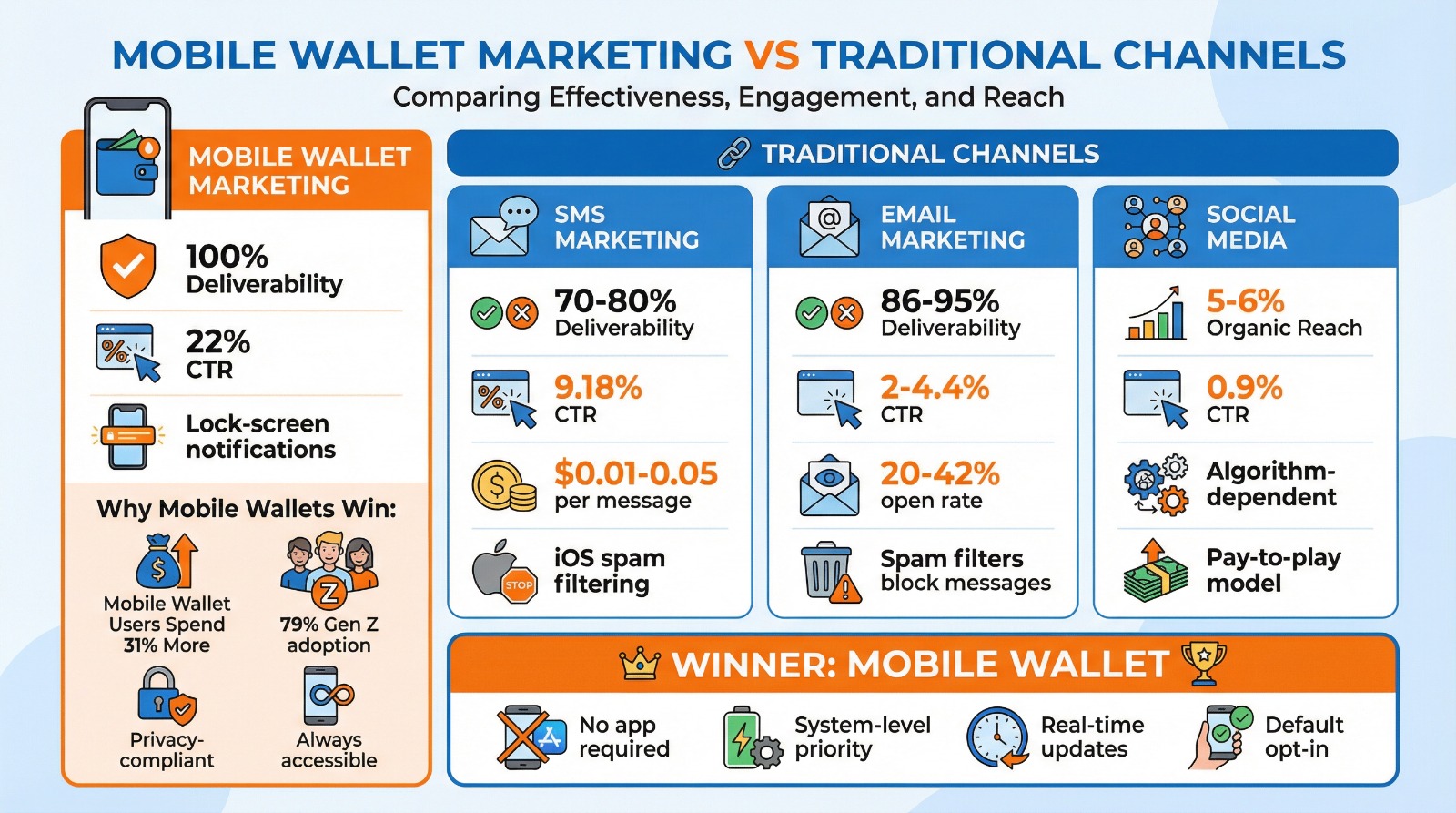
Email marketing averages a 2-4% click-through rate. That means 96 out of every 100 people ignore your email message.
Social media organic reach has collapsed to around 5-6% on platforms like Facebook and Instagram, so even the followers you spent years building barely see your content unless you pay to boost/promote it. The average click-through rate from a social media post is just 0.9%.
SMS marketing still delivers strong open rates of up to 98%, but at a cost of $0.01-0.05 per message, regularly communicating with a database of even 10,000 people becomes expensive quickly. And with iOS now filtering marketing SMS into spam folders, even that channel is losing its edge.
Then there are dedicated mobile apps. On paper, they sound like the answer. In practice, the average cost to build one ranges from $50,000 to $300,000, and even after launch, 25% of apps are used only once before being deleted.
The average app loses nearly 75% of its users within the first day. By day 30, retention drops to around 2-5% depending on the platform and industry. Over 95% of users churn within a month.
Businesses are spending more than ever to communicate with customers who are paying less attention than ever.
What Is a Mobile Wallet Pass?
A mobile wallet pass is a digital card that lives inside Apple Wallet or Google Wallet, the native wallet apps that come pre-installed on every iPhone and Android device.
No download required. No account creation. No login credentials.
The pass sits right alongside bank cards, boarding passes, and payment methods, amongst the most frequently accessed space on any smartphone.
A wallet pass can function as a membership card, a loyalty card, an event ticket, an access credential, or all of these at once. It can be updated remotely in real time, change the design, update a points balance, swap an offer, and the pass refreshes automatically on the customer's phone without them doing anything.
Most importantly, it can send push notifications directly to the phone's lock screen.
Not to an inbox. Not through an algorithm. Not via a carrier.
Directly to the lock screen, with the same priority as a bank transaction alert.
The pass is added with a single tap from a link, a QR code, or an NFC chip. It takes less than three seconds. And once it's in the wallet, it stays there, not buried in an app folder or lost in an email inbox, but visible every single time the customer opens their phone to pay for something.
The Numbers That Change the Conversation
Wallet pass notifications achieve near 100% deliverability. There is no spam filter. There is no algorithm deciding who sees the message. Every single person who holds your pass receives your notification.
According to industry data published by FanCircles, "wallet pass notifications are achieving near 100% deliverability and 22% click-through rates."
A 22% Click-Through Rate!
To put that in perspective: email achieves 2-4%. Social media posts average 0.9%. Even SMS, long considered the gold standard of direct communication, delivers around 9%.
A wallet pass notification is roughly 5.5 times more effective than SMS and up to 11 times more effective than email at driving action.
On the adoption side, 4.5 billion people globally now use digital wallets, representing over 54% of the world's population. Among Gen Z the demographic that defines future consumer behaviour, adoption sits at 79%. Among Millennials, it's 67%. Together, these two generations represent 75% of all wallet pass users.
These are not early adopters experimenting with new technology. These are people who already use digital wallets every day.
And the cost? A wallet pass can run as little as $0.096 per user per year. Less than ten cents to maintain a direct, always-on, lock-screen communication channel with a customer for an entire year.
The Five Things a Wallet Pass Gives a Local Business
1. Push Notifications That Actually Get Seen
Not filtered into a promotions tab. Not throttled by an algorithm. Not blocked by a carrier. Wallet pass notifications arrive on the lock screen with the same priority as a bank transaction alert.
This is the single most valuable feature of the mobile wallet pass. Every other marketing channel requires the customer to actively seek out your message, open the email, scroll the feed, check the app. A wallet notification meets them where they already are, at the moment you choose. And with a 22% click-through rate, roughly one in five people who see it take action.
No other channel in digital marketing comes close to that ratio.
2. Loyalty Tracking Without the Friction
No plastic cards to lose. No app to download. No account to create. No login to remember. The pass sits in the customer's wallet, updates itself in real time, and tracks every visit, every redemption, every interaction automatically. The customer sees their points balance every time they open their phone to pay for a coffee.
48% of consumers already have four or more loyalty cards saved in their digital wallet. 43% say they prefer managing their rewards and balances through a digital loyalty card. The behaviour is established, the question is whether your business is where your customers already are.
3. Digital Access That Replaces Physical Credentials
A QR code or NFC chip on the wallet pass scans at the door, the turnstile, the gate. One phone, one pass, one tap, whether the customer is entering a gym, a pool, a sports court, or a concert.
This is not theoretical. Keepcool, a fitness brand with over 400,000 members and 270+ gyms across France and Belgium, deployed mobile wallet passes integrated with their door and turnstile access controls. Within six months, over 80% of their members had adopted the mobile wallet solution. Their Chief Digital Officer, Fouad Hassani, described it as "frictionless mobile access and check-in."
Life Time, a premium fitness brand operating over 200 clubs across America, replaced their entire barcode ID system with NFC wallet passes. Members surveyed after deployment described it as "an amazing feature, it's a must have, not only is it a safe way to check in, but MUCH faster too."
The same pass works across multiple locations. A member who trains at one gym and visits another city doesn't need a new card, a guest pass, or a phone call to reception. The pass just works.
4. First-Party Customer Data That You Own
Every scan, every notification response, every redemption, every visit builds a picture of how your customers actually behave, when they visit, how often they return, which offers drive action, which locations they use. This data lives with you. Not with a social media platform. Not with a ticketing marketplace. Not with an algorithm you can't control.
For businesses operating across multiple locations or running events through third-party platforms, this is a critical shift. Ticketing platforms typically take 10-15% commission and keep the customer relationship. Social media platforms show your content to a fraction of your followers and charge you to reach the rest. A wallet pass returns ownership of the customer relationship to the business that earned it.
5. All of This at a Fraction of the Cost of a Mobile App
A custom mobile app costs tens of thousands to build, requires ongoing maintenance across two platforms (iOS and Android), and loses the vast majority of its users within the first month. Industry data shows that day-30 retention averages just 2-6%, meaning that for every 100 people who download your app, as few as 2-6 are still using it a month later.
A mobile wallet pass delivers the engagement features that matter most, push notifications, loyalty tracking, digital access, and customer data, without the development cost, without the maintenance burden, and without the friction that kills app adoption before it starts.
At less than ten cents per user per year, the economics aren't even comparable.
What This Looks Like in Practice
Membership and Access Control
A fitness centre, sports club, or leisure complex issues each member a digital wallet pass. The member scans their phone at the entrance, a QR code reader or NFC reader at the door validates the pass instantly. The same pass works across multiple locations if the business operates in more than one city.
When a membership is approaching renewal, a push notification lands on the lock screen: "Your membership expires in 7 days, tap to renew."
No email to miss. No letter to ignore. No phone call needed.
When a new facility opens, a gym, a swimming pool, a new class format, a notification reaches every member directly: "New gym now open, book your first session at 50% off."
No Instagram post competing with the algorithm. No poster on a gym wall that half the members walk past without noticing. A direct message to the lock screen, with a 22% click-through rate.
Event Ticketing
A venue that hosts concerts, festivals, outdoor fitness sessions, cultural nights, or sporting events can distribute tickets directly through mobile wallet passes. The customer receives a link, taps to add the ticket to their wallet, and arrives at the event with a scannable QR code on their phone.
No paper ticket. No PDF to print. No third-party ticketing platform taking a 10-15% commission.
SXSW, one of the world's largest and most prestigious festivals, adopted mobile wallet passes for event credentials and achieved a 25% increase in credential distribution while reducing costs by 54%.
But the real value comes after the event. Every attendee who holds a wallet pass ticket becomes a direct contact. The venue can push a notification about the next event, a special offer at the on-site restaurant, or an early-bird deal for next season, all without paying a platform fee and without surrendering customer data to a third party.
The relationship stays with the venue. Not with the ticketing platform.
Loyalty and Retention
A restaurant, café, or hospitality venue issues a wallet pass that functions as a digital loyalty card. Every visit is tracked, points accumulate, and when a reward is unlocked, a notification appears on the customer's phone.
Birthday offers. Seasonal promotions. Exclusive menu previews. Tasting events. All delivered through the wallet with a click-through rate that makes email look like sending letters by carrier pigeon.
For businesses with multiple revenue streams, a hotel that also has a spa and a restaurant, a sports complex with a gym, courts, and an events programme, a single wallet pass becomes the unified loyalty layer across all of them. The customer earns rewards whether they book a room, eat dinner, play a match, or attend a concert.
One pass. One relationship. One complete picture of customer behaviour.
Cross-Promotional Partnerships
This is where the mobile wallet pass becomes genuinely transformative for local business ecosystems.
Two or more complementary businesses, a gym and a leisure complex, a restaurant group and an entertainment venue, a hotel and a sports club, can create a shared or reciprocal wallet pass system that offers mutual benefits to members of either business.
A member of one venue receives a push notification about an event at the partner venue, with a special offer exclusive to pass holders. The notification drives foot traffic between businesses. Both parties can measure exactly how many customers crossed over, when, and what they spent.
Partnerships that previously relied on a poster on the wall or an Instagram story that 6% of followers saw suddenly become trackable, measurable, and scalable.
For businesses in cities where their customer base is mobile, students moving between university towns, professionals commuting between cities, tourists moving through a region, a wallet pass that works across locations and partner venues creates continuity that no other channel can match.
A student who moves cities for university doesn't become a lost member. They become a mobile member whose pass works at the new location, who receives relevant notifications about what's happening where they are now, and who gets welcomed back with a targeted offer when they return home for the holidays.
That's not customer retention. That's customer relationship architecture.
Important Considerations
Notification frequency must be managed carefully. The power of wallet pass notifications is their visibility, but that power cuts both ways. Too many irrelevant messages and the customer deletes the pass.
Every notification must be a genuine value exchange: the customer's attention in return for something useful, timely, and relevant.
Quality over quantity is not optional. It's essential.
Adoption is organic, not instant. Not every customer will add the pass on day one. The Keepcool case shows that within six months, over 80% of members had adopted, but that adoption was driven by clear, tangible value: faster entry, no need for a physical card, seamless access across locations. Businesses that lead with value see the pass spread naturally. Businesses that try to force adoption without demonstrating value see lower retention.
It requires ongoing content and strategy. A wallet pass is not a "set it and forget it" tool. It's a live communication channel that needs regular, thoughtful content, promotions, event announcements, seasonal offers, partnership activations. Businesses that treat it as a living channel see compounding returns. Businesses that send one notification and go quiet see the pass forgotten.
Partner coordination takes effort. For cross-promotional ecosystems involving multiple businesses, all parties need to align on shared benefits, notification schedules, and data practices. Technology is the easy part and human coordination is what makes or breaks a multi-venue deployment.
It does not replace existing operational tools. Booking systems, POS platforms, reservation software, and management apps all continue to do their jobs. The wallet pass is the engagement and marketing layer that sits on top of everything else, connecting the customer to the business between transactions. It fills the gap that operational tools were never designed to address.
The Opportunity Window
Mobile wallet technology is in a remarkable position right now.
The infrastructure is mature. Apple Wallet and Google Wallet are installed on billions of devices worldwide. Consumer behaviour is established, over half the global population already uses digital wallets daily. The engagement data is proven, 22% click-through rates, near-perfect deliverability, and retention that dwarfs every other digital channel.
Yet the vast majority of local businesses, gyms, restaurants, hotels, leisure venues, event spaces, sports clubs, have never heard of mobile wallet passes as a marketing tool. They associate Apple Wallet with bank cards and boarding passes, not with membership programmes and push notification campaigns.
In many markets, especially emerging ones across Eastern Europe, the technology is virtually unknown among local marketers and business owners.
This creates a first-mover advantage that won't last forever.
The businesses that adopt wallet pass technology now build direct, owned relationships with their customers before the channel becomes crowded. They collect first-party data while competitors are still relying on rented audiences on social media. They create seamless experiences across locations and partnerships while others are still handing out paper loyalty cards and hoping Instagram shows their posts to more than 6% of their followers.
The technology exists. The consumer adoption is there. The performance data is overwhelming.
The only question is who moves first.